


First posted June 2020; Last updated July 2026
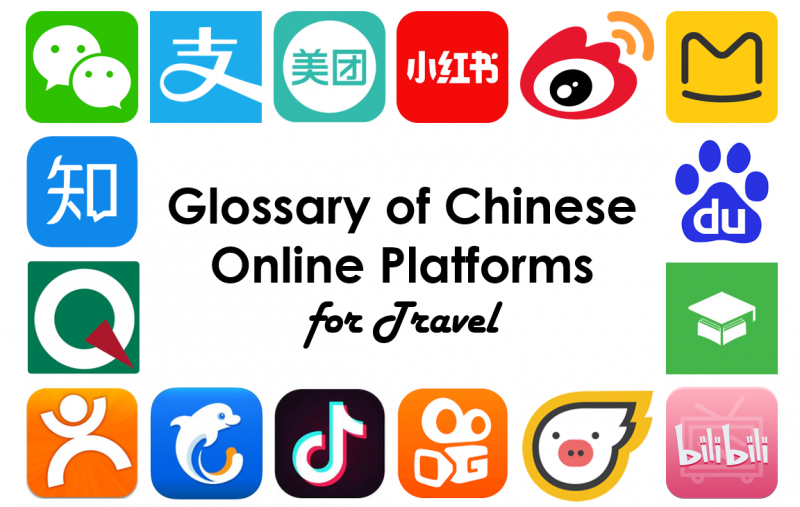
The Chinese online landscape is totally different to that in the West, and this includes apps and websites used to research, book, navigate, and share travel experiences. We’ve created a glossary to the must-know OTAs, social media, and other platforms you need to know to understand China’s online travel market.
We’ll keep adding to and updating this glossary, and please get in touch if you think we’ve missed anything!
Alibaba: One of China’s “internet giants,” comprising e-commerce platforms Taobao and Tmall; travel marketplace Fliggy; and leading mobile payment provider Alipay.
Alipay: Launched in 2004 as a payment method for e-commerce site Taobao, this is the Chinese mobile payment platform with the biggest market share (around 55%), accepted in more than 55 countries, and with 900 million users. Users pay for goods and services by scanning a QR code in the Alipay app, which also provides nearby business information and push notification marketing. Learn more about Chinese mobile payments
Baidu: China’s leading search engine, and another one of the three Chinese “internet giants.” Baidu’s popularity and revenue have declined recently, as new competitors emerge and Chinese consumers turn to in-app searches.
Bilibili: A video-sharing platform that also offers live streaming, as well as subtitling and commentary functions for videos. With longer videos than Douyin, BiliBili is gaining popularity among young Chinese, with 348 million MAUs and taking up an average of 99 minutes a day for users (February 2025). But its relevance for travel is limited, and it is not used for promotion by tourism organizations. At present, it is more oriented towards ACGN (anime, comics, gaming, and novels) culture and science/technology.
ByteDance: A leading Chinese internet company, most well-known for its short-video platform Douyin, and its international version, TikTok, as well as news-reading app and website Jinri Toutiao (“Today’s Headline”).
CTA: China Travel Academy is a WeChat-enabled online training platform developed in 2015 by Dragon Trail Interactive to train Chinese travel agents. It has been used by more than 20 international travel destinations and companies. Learn more about CTA
CTA Live: Launched in 2018, this online webinar platform is a complement to China Travel Academy (CTA). It allows international travel brands to deliver live training to Chinese travel agents through WeChat. The platform supports video and slide sharing, and interactive Q&A, and recorded sessions are available for travel agents to play back any time. Learn more about CTA Live
Ctrip: Officially known as the Trip.com Group since late 2019, this is China’s largest OTA (online travel agency), and the second-largest OTA in the world.
Dianping: An online review platform that’s especially popular in China for restaurants, but includes all kinds of venues. Users tend to be millennials in top-tier cities. It has become increasingly international in recent years, and the website and/or app can be used to find Chinese-language information and reviews for restaurants, attractions, hotels, and other businesses in cities around the world. Around one-third of Chinese travelers in Dragon Trail’s survey say they use it to find outbound travel information. The full Chinese name is Dazhong Dianping.
Douban: A well-established culture-focused online forum. Content includes reviews and discussions of books, movies, and music, but some users share travel experiences as well.
Douyin: A short-video and live streaming platform that is the Chinese – and original – version of TikTok. It’s China’s most important video platform for travel inspiration and information, with more than 400 million users interested in travel. Establishing an official account or broadcasting live streams from overseas are both difficult to do, so influencer marketing is a good choice here. Please note that Douyin and TikTok are not the same thing, even though they have the same logo and interface – videos posted on TikTok are not visible to Douyin users, and vice versa.
Douyu: One of China’s 200+ live streaming platform, particularly popular with younger users. Learn more about live streaming for tourism
Fliggy: The travel arm of Chinese internet giant Alibaba. It is more of a “travel marketplace” than a traditional OTA, with travel brands, such as airlines and hotels, running their own “shops,” in the style of an e-commerce platform. Fliggy has grown to almost one-third of the outbound travel market share. It’s the market leader for young travelers and independent travelers.
Jinri Toutiao: China’s most prominent news reading app, developed by ByteDance. Today’s Headline, or Jinri Toutiao, allows users to select specific people, topics, and news sources to create a customized list of headlines to scan.
Kuaishou: China’s second-most popular short video platform after Douyin, with 772 million monthly active users as of Q1 2026. The app is particularly popular with younger users in lower-tier cities.
Meituan-Dianping: A Chinese internet company comprising a variety of different apps and services, including food delivery, cinema ticket booking, and review platform Dazhong Dianping. Meituan Travel has become China’s leading platform for hotel bookings and is especially popular with younger users, but the focus is still on domestic travel.
Mafengwo: A travel review website popular with millennial FITs, providing city and destination pages, venue listings and reviews, travel diaries, a Q&A forum, self-driving route recommendations, and a live streaming platform. Mafengwo also offers its own AI travel assistant and has worked with destination tourism boards to create AI guides.
Mini-Program: Introduced to WeChat in 2017, mini-programs are like light apps accessible within WeChat, so users don’t need to download or open any other app to access them. They can offer functionalities including bookings, maps, and guides, and they are expected to become more important with the introduction of WeChat’s agentic AI tool in 2026. RedNote has also launched its own mini-programs, used for e-commerce and bookings.
Pugongying: Literally “Dandelion”, this is RedNote’s influencer platform, where brands can find and collaborate with RedNote KOCs and KOLs with more than 1,000 followers. RedNote also offers another interface called the Creator Hub, which is like a light version of Pugongying that allows brands to pay to boost UGC posts by users with fewer than 1,000 followers and contact users that have mentioned them.
QQ: Tencent’s original instant messaging platform, before WeChat was launched. Rather than fading into obscurity like AIM or ICQ, QQ is still used in China and has seen a revival among younger generations. It is used primarily for chatting with friends and for transferring large files.
Qunar: China’s second-largest OTA. Like Ctrip, this is part of the Trip.com Group. It focuses slightly more on domestic and discount travel, although it does have overseas travel products as well.
Qyer: Founded by Chinese students and backpackers in Germany in 2004 to find travel companions and share tips, this travel review website is most popular with millennial FITs and offers a number of features, including reviews, travel diaries, a forum, professionally written guidebooks, and some OTA services, offered in partnership with Booking.com.
RedNote/Xiaohongshu: Also known as Little Red Book, or RED. It’s been around since 2013, but its popularity for sharing and searching for travel content surged from 2020 onwards. The app has seen incredible growth in user numbers from just 30 million in April 2018 to 300 million at the end of December 2023. Dragon Trail Research shows that RedNote is well ahead of other social media platforms as a source of information for planning an outbound trip, with more than half of respondents in our traveler survey using RedNote to find information about outbound travel destinations. It’s especially popular with affluent young women in first-tier cities. Learn more about Xiaohongshu
Tencent: China’s first “internet giant,” founded in 1998 (Alibaba was founded in 1999, and Baidu in 2000). Parent company of QQ and WeChat.
Tongcheng: An OTA that’s owned by WeChat parent company Tencent. It’s integrated into WeChat for travel bookings – transportation bookings make up nearly half of their income.
Tuniu: A Chinese OTA with a long history and investment from both Ctrip and Tencent. Its focus is mainly on group travel, especially for long-haul destinations
WeChat: China’s leading social media platform and mobile app, with more than 1.4 billion monthly active users as of 2026. Nicknamed the “Swiss Army Knife app” because of its wide range of functions, including chat, voice and video calls, social sharing on WeChat Moments, official accounts, WeChat Pay mobile payments, utilities payments, travel booking, WeChat mini-programs – light apps within the WeChat interface, and more. WeChat is a vital platform for work communications in China, as well as personal ones. Learn more about WeChat
Weibo: A micro-blogging platform that’s in some ways similar to Twitter/X in its layout, but allows for more photos and text. Founded in 2009, this is one of China’s oldest social media platforms and as of 2026 has approximately 591 million monthly active users. Owned by the Sina internet company, Weibo is especially popular with influencers and for following celebrities and luxury brands. For marketers, Weibo stands out as a platform for viral content and communicating in an open space. Learn more about Weibo for tourism marketing
Xiaohongshu: See RedNote.
XiaoWei: WeChat’s agentic AI tool, in closed beta launch from June 2026, with full rollout expected for summer 2026. XiaoWei operates WeChat on users’ behalf, with either written or spoken commands. It sends messages, creates group chats, books hotels, orders dinner, and drafts Moments posts, using data and Skills accessed from the WeChat ecosystem, including mini-programs, brand accounts, and chats.
Youku: China’s version of YouTube, this video platform includes longer videos, with streaming services and a focus on professionally produced content.
Zhihu: A Q&A forum, similar to Quora, with a significant amount of travel-related content and advice. Zhihu’s monthly active user numbers have actually been decreasing in recent years, to 81 million by 2025, but these users are increasingly engaged. It’s a trusted community, with users more likely to be young, female, and living in first-tier cities.
Zuzuche: China’s leading online car rental company. Learn more about Chinese self-driving tourism
The wonderful partners we work with






Sign up for our free newsletter to keep up to date on our latest news
We do not share your details with any third parties. View our privacy policy.
This website or its third party tools use cookies, which are necessary to its functioning and required to achieve the purposes illustrated in the cookie policy. If you want to know more or withdraw your consent to all or some of the cookies, please refer to the cookie policy. By closing this banner, scrolling this page, clicking a link or continuing to browse otherwise, you agree to the use of cookies.