


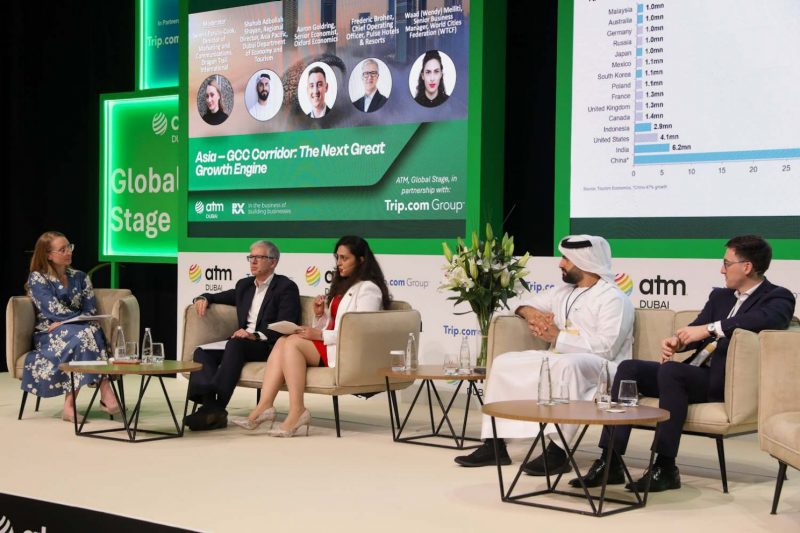
Dragon Trail’s Sienna Parulis-Cook moderated a panel discussion on the Asia-GCC travel corridor at ATM Dubai, with speakers (left to right) Frederic Brohez from Pulse Hotels & Resorts, Wendy Melliti from WTCF, Shahab Shayan from the Dubai Department of Economy and Tourism, and Aaron Goldring from Tourism Economics
Dragon Trail joined WTM Spotlight Riyadh and ATM Dubai 2026 as an official Research Partner this September, launching our 2026 white paper on Chinese tourism to MENA and a special report on Chinese tourism to Saudi Arabia. But these two travel industry events were not just platforms for us to share our consumer and travel trade research, but also valuable opportunities to learn more about region first-hand, and from industry colleagues working to develop this market on a daily basis. With insights covering trends, opportunities, challenges, and forecasts, here are our six top takeaways from WTM Spotlight Riyadh and ATM Dubai 2026.
1. Chinese business integration in MENA continues to grow, driving travel demand
While leisure travel has slowed in recent months, Chinese business travel is back in the GCC (Gulf Cooperation Council, comprising Saudi Arabia, Kuwait, Bahrain, Qatar, the UAE, and Oman), helping to fill flights and hotel rooms. At Dubai’s Mövenpick Hotel Jumeirah Beach, Senior Sales Manager – MICE, Salka Essarhayar, says that “business is bouncing back”, driven by corporate travel, business travel, and MICE. She shared an example of the Chinese company TCL Technology, which booked 40 rooms for five nights this August for a product launch. In February, the hotel also hosted a large group from Chinese EV company BYD. Another luxury hotel in the emirate, the Atlantis Dubai also sees China as a key market for large events, especially in the tech and automotive sectors, says Rohith Suvarna, Manager, Business Development – Sales.
It’s also not just about Chinese business travelers coming to MENA for events and meetings – those who are already living and working in the region are helping to develop the market in numerous ways. Shahab Shayan, Regional Director Asia Pacific at the Dubai Department of Economy and Tourism, says more Chinese companies are opening offices in Dubai. Lynn Mhanna, Director of Sales and Marketing at the Fairmont Riyadh, has noticed an increase Chinese restaurants in the Saudi capital. Tourism Trade Relations Manager at Diriyah, Rakan Alabodi says that earlier in the year Chinese were the second nationality after local Saudis to visit Bujairi Terrace – a shopping and dining area adjacent to the At-Turaif UNESCO site – with many of these Chinese visitors assumed to be locally based or regional expats. Aseer, the “Zurich of the GCC” in Saudi Arabia, has seen a 137% increase in Chinese visitors this year, with a majority of these regionally based, says General Manager of the Aseer Development Authority, Mohamed Khater.
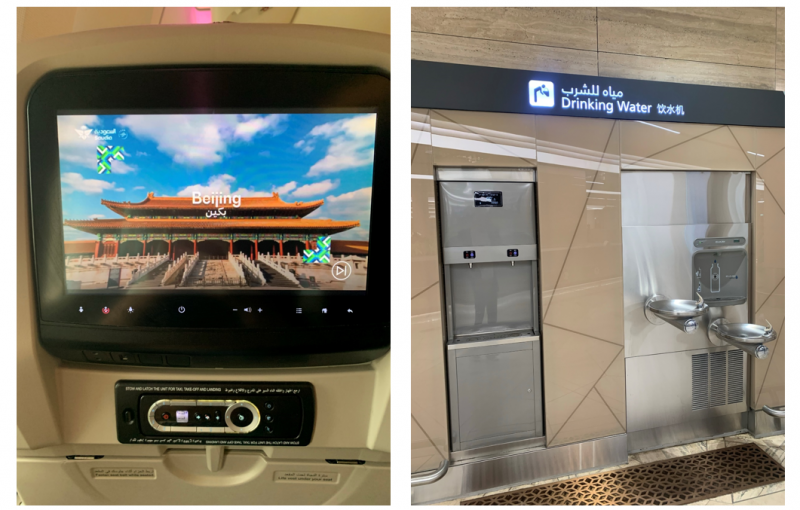
(Left) Saudia Airlines is flying full capacity to and from China; (Right) Chinese signage and hot water dispensers at King Khalid International Airport in Riyadh
2. Saudi Arabia is going all-in on China
Many destinations throughout the GCC and MENA have successfully attracted growth in Chinese visitors and business connections in recent years, but Saudi Arabia seems to be making the biggest and most coordinated push in this direction. Out of four GCC airports visited on the trip, Riyadh’s is the only one with Chinese signs – something Chinese travelers frequently post about on RedNote, too. There’s even a hot water dispenser – a rarity outside of China – in the baggage reclaim area. Again at the Saudi National Museum, Chinese is the only foreign language other than English found in the exhibits. “The future is East,” says the Fairmont Riyadh’s Lynn Mhanna, explaining that Mandarin is now being taught in Saudi schools. Al Qasr Hotels & Resorts’ Customer Service Manager Dr. Ameni Zaouali has also noticed a significant increase in the study of Chinese language in Saudi Arabia. For now, demand exceeds supply for Chinese-speaking, local tour guides, and Diriyah’s Tourism Relations Senior Manager Salman Al Ali says there are plans to recruit young Saudis who are currently studying in China.
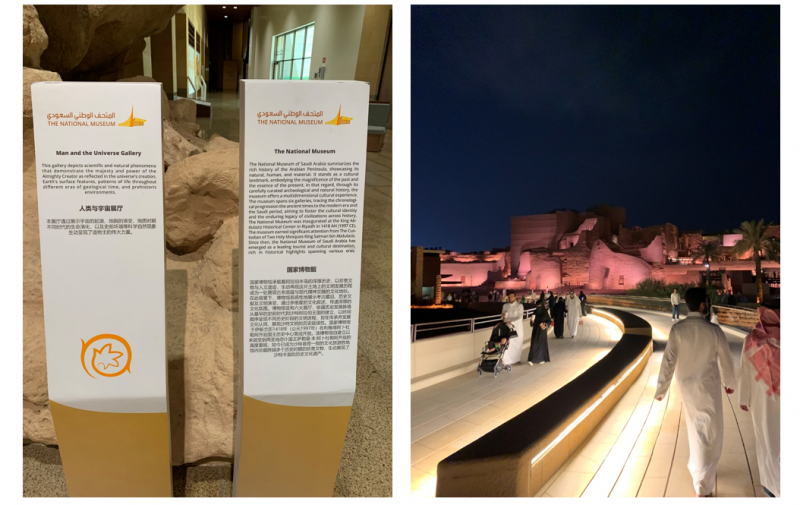
(Left) Chinese-language signs at the Saudi National Museum; (Right) The walkway from Diriyah’s Bujairi Terrace to the At-Turaif UNESCO Site
3. Luxury is a starting point – but destinations are focused on diversification
Dragon Trail’s travel trade research shows that China’s luxury market currently holds the greatest potential for recovery and growth to Saudi Arabia and throughout the MENA region. But this is just intended to be the beginning, as the country targets a broader audience in the long-term. In Diriyah, a “city within a city” being built on the outskirts of Riyadh, the luxury hotels are coming first – to capture those initial travelers and the brand recognition for names like Aman and Cappella. But the long-term plan is to build hotels for all budgets, alongside an opera house, arena, museums, and other cultural attractions.
Further outside of Riyadh, the new city of Qiddiya is intended to be a center for fun and entertainment, including theme parks and world-class sporting venues. Zaineb Akbiri, Associate Director – International Sales, says China is a focus for Qiddiya because of the size and potential of its mass market rather than the more niche, luxury segment.
Similar market diversification is also a focus for a very different destination to Saudi Arabia: The Maldives. This island nation is shifting away from its traditional image of a luxury honeymoon hotspot. This is something we’ve already seen in recent years from the Chinese market, where family travel is the dominant market segment holidaying in the Maldives. Frederic Brohez explained that Pulse Hotels and Resorts have introduced facilities and activities such as escape rooms and a bowling alley, with products for solo travelers and multi-generational family groups. Managing Director for marketing company Localture Maldives, Abdulla Nahil works with local island councils to promote smaller destinations and hospitality brands in the Maldives, beyond the big-name luxury resorts.
4. Hospitality providers are adapting their menus and products on the go
Hotels and other hospitality providers throughout MENA are taking flexibility to the next level by adapting their offerings to suit incoming guests. Forget about a buffet with fixed international cuisine stations – now, a restaurant first checks who they’re going to serve, and creates a menu to match. We first heard about this from Mahmoud Basyouny at Cruise Saudi, who explained that the cruise line updates its food and entertainment offerings to suit the guests on that particular sailing – for example, recruiting a Russian comedian to perform on-board for a sailing with a particularly high proportion of Russian guests. Several UAE hotels also confirmed that they too adjust their buffet menus when they’re expecting large groups of a certain nationality, such as Chinese or Indian. In a market where travelers are increasingly looking for bespoke experiences, these hospitality providers are doing the difficult work to stay agile and adaptable.
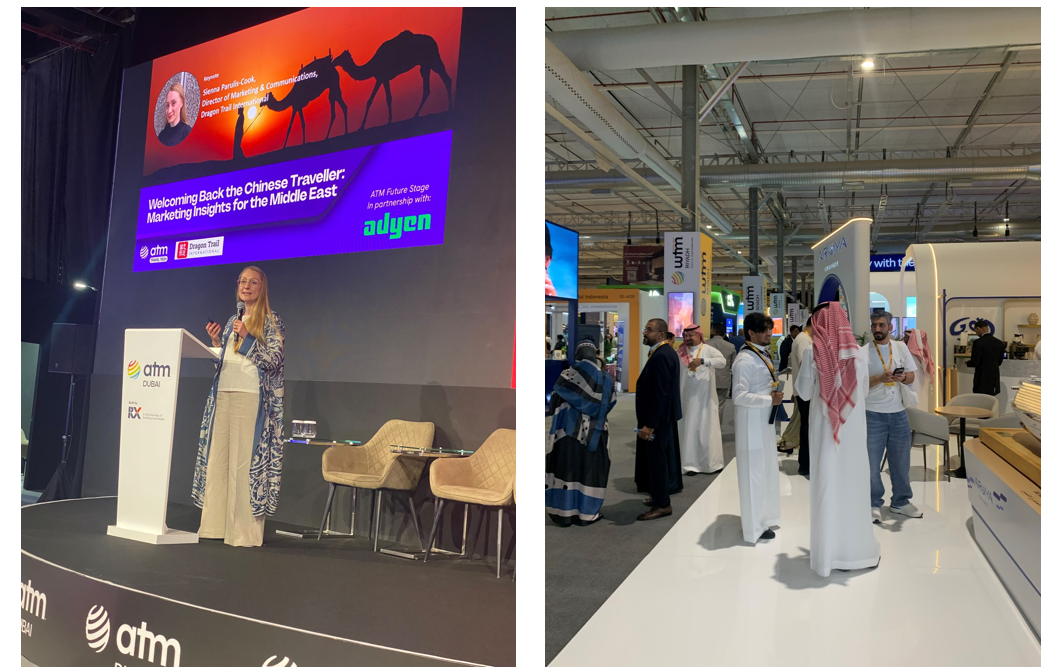
(Left) The launch of Dragon Trail’s 2026 white paper on Chinese tourism to MENA at ATM; (left) Exhibition floor at WTM Spotlight Riyadh
5. The recovery of Chinese tourism to MENA depends on flight resumptions
There is consensus throughout the GCC that the resumption of flights by Chinese carriers are essential to market recovery – even with local carriers like Emirates, Qatar Airways, and Saudia already back to full capacity. Nooruddin Hafiz, Cluster Senior Sales Manager at the soon-to-open Raffles Red Sea, says the hotel is waiting for Air China flights to resume before launching China marketing activities. Diriyah and Qiddiya are also watching and waiting for Air China and China Eastern. At WTM Spotlight Riyadh, the expectation was that Chinese flights were due to return to Saudi Arabia by October. The following week at ATM, Xiaoqin Ding from Visit Qatar said the Civil Aviation Authority of China was still evaluating and allocating flight schedules, with Doha flights potentially resuming in Q4 – she thinks the main obstacle to market recovery is the reduced air capacity. Schedules to the UAE also seem uncertain – Atlantis Dubai’s Rohith Suvarna says a large Chinese group scheduled for December has already been postponed because the Chinese airlines have not resumed service.
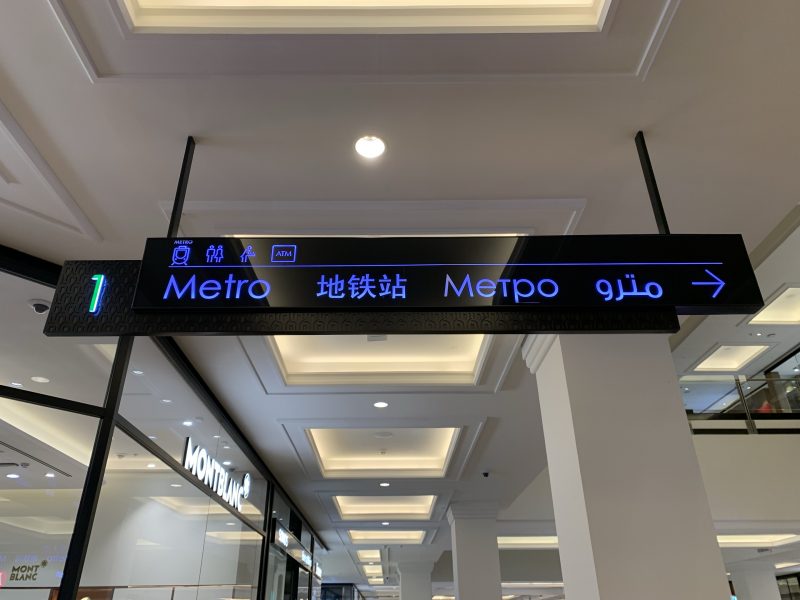
Signs at the Mall of the Emirates in Dubai are in English, Chinese, Russian, and Arabic
6. UAE travel brands forecast market recovery in 2027
Last week, Skift reported the UAE hotels have “given up” on Q4 and are looking to 2027 for recovery. This is also what we heard from the travel industry in Dubai, Ras Al Khaimah, and Abu Dhabi, with most looking to the start of 2027 or even later to come back from the disruption of this year. This aligns with Dragon Trail’s research on the Chinese market, which found that 26% of Chinese travelers interested in visiting MENA would not consider doing so in the next three months, with 22% saying they wouldn’t consider it within the next three months. However, Chinese consumer sentiment becomes much more positive when we look ahead to the next 1-3 years, with just 6% saying they wouldn’t consider travel to the region, and 57% saying they would look forward to traveling there. We forecast that significant recovery for the Chinese tourism market to MENA will come during the 2027 Chinese National Day holiday in October, if the region remains stable.
For more information on Chinese consumer and trade sentiment and travel plans for the Middle East and North Africa, please download our September 2026 white paper.
The wonderful partners we work with






Sign up for our free newsletter to keep up to date on our latest news
We do not share your details with any third parties. View our privacy policy.
This website or its third party tools use cookies, which are necessary to its functioning and required to achieve the purposes illustrated in the cookie policy. If you want to know more or withdraw your consent to all or some of the cookies, please refer to the cookie policy. By closing this banner, scrolling this page, clicking a link or continuing to browse otherwise, you agree to the use of cookies.